

Reviewed by Mr. Hugh Mostafid (Royal Surrey County Hospital, Guildford, UK)
UTUC: similarities and differences compared to bladder cancer
While bladder tumours account for 90-95% of all urothelial carcinomas (UCa), only 5-10% of UCa cases involve the upper urinary tract [1].
Similar to bladder cancer, the most common symptom of upper tract urothelial carcinoma (UTUC) is gross or microscopic haematuria (70-80% in UTUC). This is followed by flank pain (20-32%), and in more advanced cases with UTUC, anorexia, weight loss, malaise, fatigue, fever, night sweats, and cough [1,2].
UTUC is associated with a higher mortality rate compared to bladder cancer (>50% vs <25%, respectively, at 5 years from diagnosis) [3].
Common tools used to diagnose UTUC
CT urography, ureteroscopy (URS) and urinary cytology are often used to diagnose UTUC. However, these tools are not flawless in detecting UTUC and are associated with some disadvantages:
• CT urography: despite having a very high overall diagnostic accuracy (92% sensitivity and 95% specificity), CT urography cannot detect carcinoma in situ and flat lesions [1,3].
• URS: like a urethrocystoscopy, URS is used to visualise the tumour from inside the urinary tract. However, this procedure is invasive, requires general anaesthesia and an operation room, it is burdensome, and can lead to serious complications such as perforations, bleeding, infections and tumour seeding [1,3,4].
• Urinary cytology can be performed either on voided urine or on urine collected from the affected upper tract (selective cytology). Despite a high specificity of about 90%, the sensitivity of selective cytology remains limited (53%) [5].
In this context, urinary biomarker tests could be an alternative method for the diagnosis of UTUC.
Is there a place for urinary biomarkers?
To demonstrate their diagnostic value, biomarker tests should have high sensitivities and negative predictive values (NPV) to ensure a low number of missed diagnosis, and high specificities and positive predictive values (PPV) to minimise the number of unnecessary procedures driven by false positive results.
A recent study evaluating the diagnostic performances of urinary biomarkers for UTUC in 97 urine samples collected from the upper tract found that Bladder EpiCheck®, Urovysion®-FISH and Xpert® Bladder Cancer Detection have higher overall sensitivities and NPV compared to cytology [6].
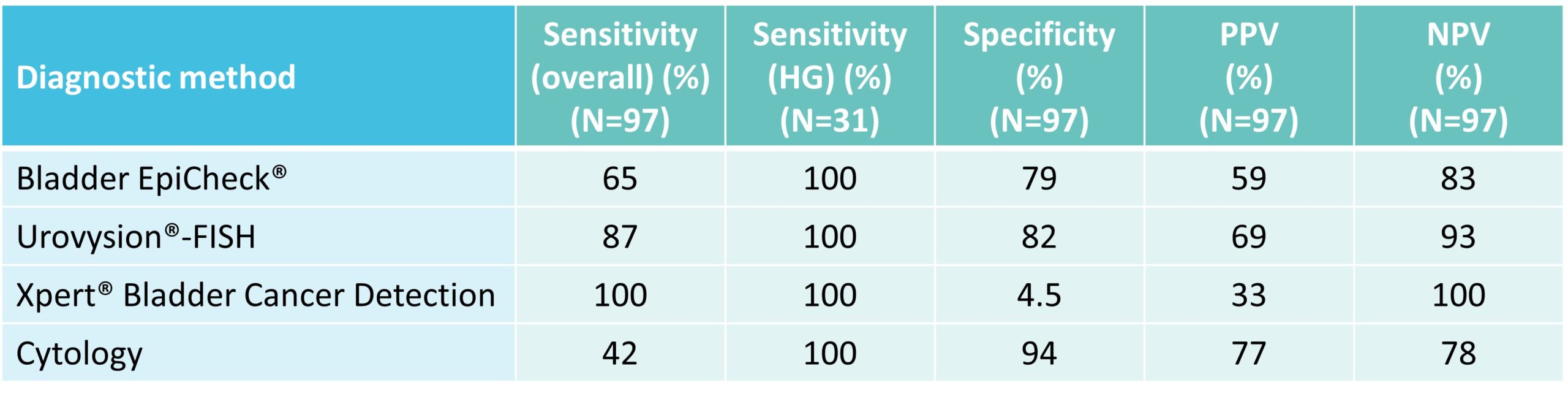
Disease prevalence: 32% all grades, 16% HG. HG: high grade; NPV: negative predictive value; PPV: positive predictive value
The high specificity and PPV of Bladder EpiCheck® and Urovysion®-FISH ensure a low number of false positives.
The authors of the study concluded [6]:
Sensitivity of cytology is low in low-grade tumours thus having a high specificity.
Manipulation during URS seems to decrease the specificity of the Xpert® Bladder Cancer Detection, limiting its usefulness in the diagnosis of UTUC.
Bladder EpiCheck® and Urovysion®-FISH show acceptable sensitivity and specificity and along with cytology they could be helpful ancillary methods for the detection of UTUC and useful in the follow-up of patients after UTUC.
Indeed, the EAU guidelines suggest that in the future, URS might be avoided in selected patients with a positive urinary biomarker test [1]. However, the low number of cases included in the study cannot allow any definitive conclusions and multicentric, randomized studies are needed [6].
References
- Rouprêt M, Gontero P, Birtle A, et al. European Association of Urology (EAU) guidelines on upper urinary tract urothelial carcinoma. Update March 2023. Available at: https://uroweb.org/guidelines/upper-urinary-tract-urothelial-cell-carcinoma
- Petros FG. Transl Androl Urol 2020;9:1794-8. PubMed
- Coleman JA, Clark PE, Bixler BR, et al. Diagnosis and management of non-metastatic upper tract urothelial carcinoma: AUA/SUO guideline. J Urol 2023;209:1071-81. Update April 2023. Available at: https://www.auanet.org/guidelines-and-quality/guidelines/non-metastatic-upper-tract-urothelial-carcinoma
- D’Elia C, Trenti E, Krause P, et al. Ther Adv Urol 2022;doi: 10.1177/17562872221090320. PubMed
- Zganjar AJ, Thiel DD, Lyon TD. Transl Androl Urol 2023;12:1456-68. PubMed
- Pycha S, Trenti E, Mian C, et al. World J Urol 2023;41:1323-8. PubMed