

Improving detection of high-grade recurrences missed by WLC using a urinary biomarker
Reviewed by Marek Babjuk
Surveillance for non-muscle-invasive bladder cancer (NMIBC) relies on routine white-light cystoscopy (WLC) and urinary cytology as the diagnostic cornerstone [1]. WLC demonstrates a sensitivity of approximately 86% for detecting papillary tumours, while specificity varies widely between 43% and 98% [2,3] depending on the examiner’s experience. The sensitivity of WLC in carcinoma in situ (CIS) is even lower than in papillary lesions, resulting in a substantial rate of overlooked tumours [2]. Similarly, urinary cytology has only a moderate sensitivity of 54% for detecting high-grade (HG) tumours, meaning that about 46% of HG tumours, including CIS, are missed [4].
Recently published real-world data suggest that Bladder EpiCheck® (BE) may achieve more efficient detection of HG recurrences compared to WLC, particularly for detecting CIS [5].
Within this study, 315 surveillance visits were analysed. At each visit, patients underwent both WLC and BE testing. Positive WLC and/or positive BE results led to photodynamic diagnosis (PDD)-guided biopsy or resection under general anaesthesia, whereas pathology result was used as the diagnostic reference.
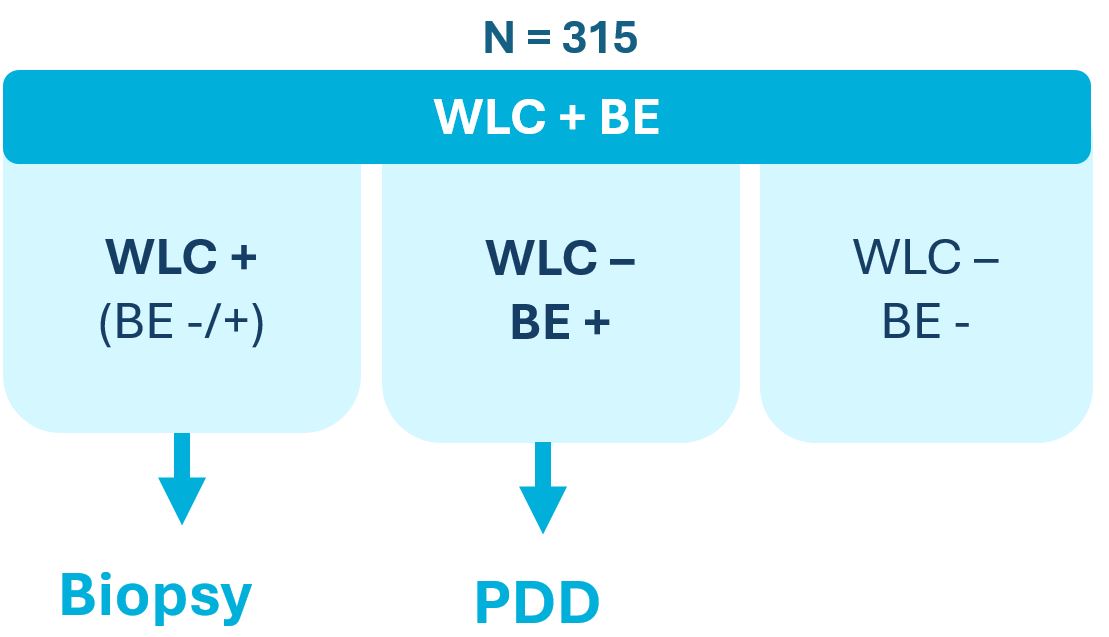
Comparative diagnostic performance
BE outperformed WLC, particularly for detecting HG and CIS lesions:
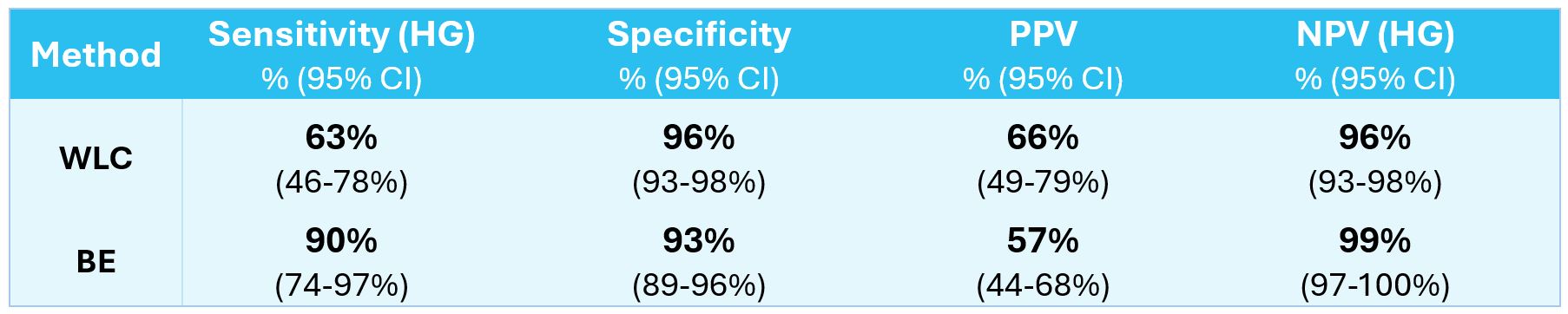
BE identified 60% more HG recurrences than WLC. Among HG tumours missed by WLC but detected by BE, 73% were CIS. Overall, WLC detected only 38% of CIS lesions versus 92% with BE. In addition to superior HG detection, BE identified all low-grade recurrences (7/7), compared to WLC (4/7), indicating consistent performance across grades.
The lower sensitivity of WLC at 63% for HG disease compared to typical literature values stems from using PDD-guided biopsy triggered by a positive BE result as the rigorous gold standard, which uncovers many flat CIS lesions invisible under WLC. In this study, PDD-guided biopsy captured additional HG recurrences (mostly CIS) that WLC missed, unlike studies using only WLC-targeted resection histology as reference.
The modest PPV mainly reflects anticipatory positives from BE As longer follow‑up and PDD‑guided biopsies confirm these initial “false positives” as real recurrences, PPV rises toward 70%, indicating BE uncovers clinically relevant but initially invisible cancer.
BE’s high NPV (99%) and specificity (93%) for HG tumours mean that a negative BE result is associated with a very low likelihood of missed aggressive disease.
Clinical interpretation
A surveillance approach guided by BE with PDD-guided biopsy reserved for BE-positive cases could potentially reduce 93% of the unncessary cystoscopies, while still detecting nearly all HG recurrences. This strategy would allow earlier and more efficient identification of aggressive recurrences.
These findings provide real-world evidence that a marker-guided, risk-adapted model can be both safe and feasible and aligns with the recently published German UroFollow trial, which also showed that marker‑based follow‑up can safely reduce cystoscopy intensity in NMIBC [6].
[References]
- Gontero P, Birtle A, Compérat E, et al. EAU Guidelines on Non-Muscle-Invasive Bladder Cancer (TaT1 and CIS). Update March 2025. Available at: org/guideline/non-muscle-invasive-bladder-cancer
- Daneshmand S, Bazargani ST, Bivalacqua TJ, et al. Urol Oncol 2018; 36:361.e1-6. PubMed
- Jocham D, Stepp H, Waidelich R, et al. Eur Urol 2008; 53:1138-50. PubMed
- Freifeld Y, Lotan Y, et al. BJU Int 2019 ; 124 :251-7. PubMed
- Mariappan P, Hart-Brooke J, Sparks R, et al. Eur Urol Oncol 2025; doi: 10.1016/j.euo.2025.11.007. PubMed
- Schmitz-Dräger BJ, Bismarck E, Roghmann F, et al. Eur Urol Oncol. 2025;8(4):1041-9. PubMed