

Key perspectives from the EAU guidelines panel
Reviewed by Paolo Gontero
The current standard-of-care for NMIBC surveillance
The 2025 EAU guidelines recommend cystoscopy as standard-of-care for the surveillance of all patients with non-muscle-invasive bladder cancer (NMIBC) [1]. However, cystoscopy is an invasive procedure that many patients find burdensome. While some non-invasive urinary biomarkers are commercially available, HCPs face difficulties in interpreting the data and translating it to clinical practice. To address this, the EAU guidelines panel published an article to shed some light into their clinical implementation.
Key characteristics of urinary biomarkers
Four key outcomes are commonly measured to evaluate the utility of urinary biomarkers in the detection of NMIBC recurrence during surveillance: sensitivity, specificity, positive predictive value (PPV) and negative predictive value (NPV) [2].
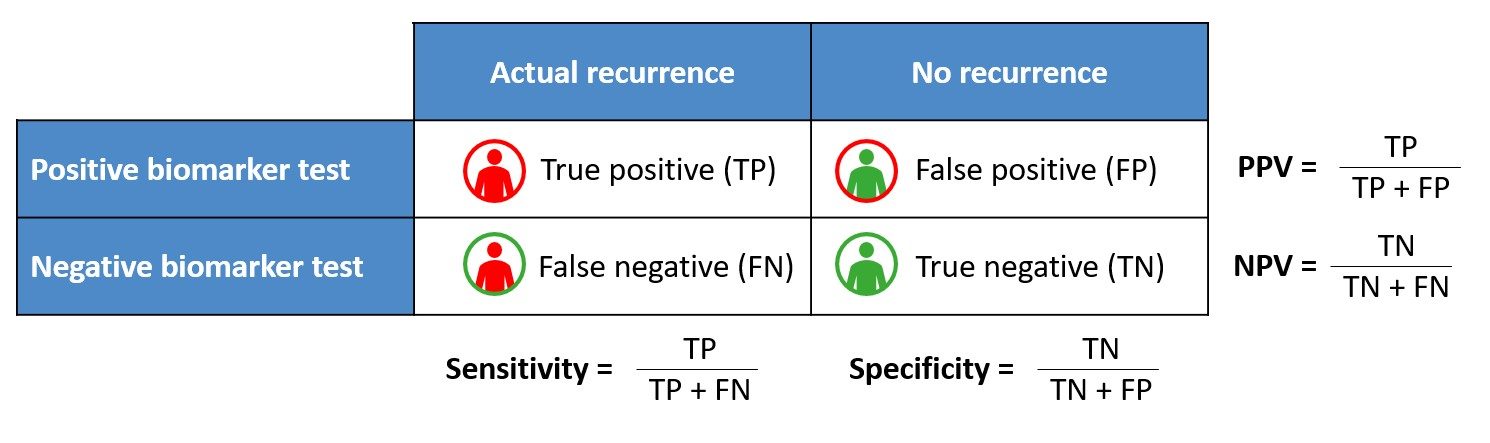 |
| Image modified from Monaghan TF, et al. Medicina (Kaunas) 2021 [3]. |
To safely postpone or replace cystoscopy (rule out), urinary biomarkers should have high sensitivity, specificity and NPV [2]. Of importance, NPV, as well as PPV, are influenced by the prevalence of disease recurrence, which should therefore be considered when interpreting the clinical usefulness of biomarkers. This was clarified in the article with an example of a urinary biomarker that fails to detect any recurrences in a cohort where 15% of patients actually experience recurrence, resulting in an NPV of 85% despite lacking clinical utility.
Besides these common performance measurements, the EAU guidelines panel also recommends using the likelihood ratio, a coefficient that evaluates biomarker accuracy. The likelihood ratio reflects the magnitude a biomarker result can improve the probability of ruling in or ruling out the presence of bladder cancer. It is calculated as follows [2,4]:
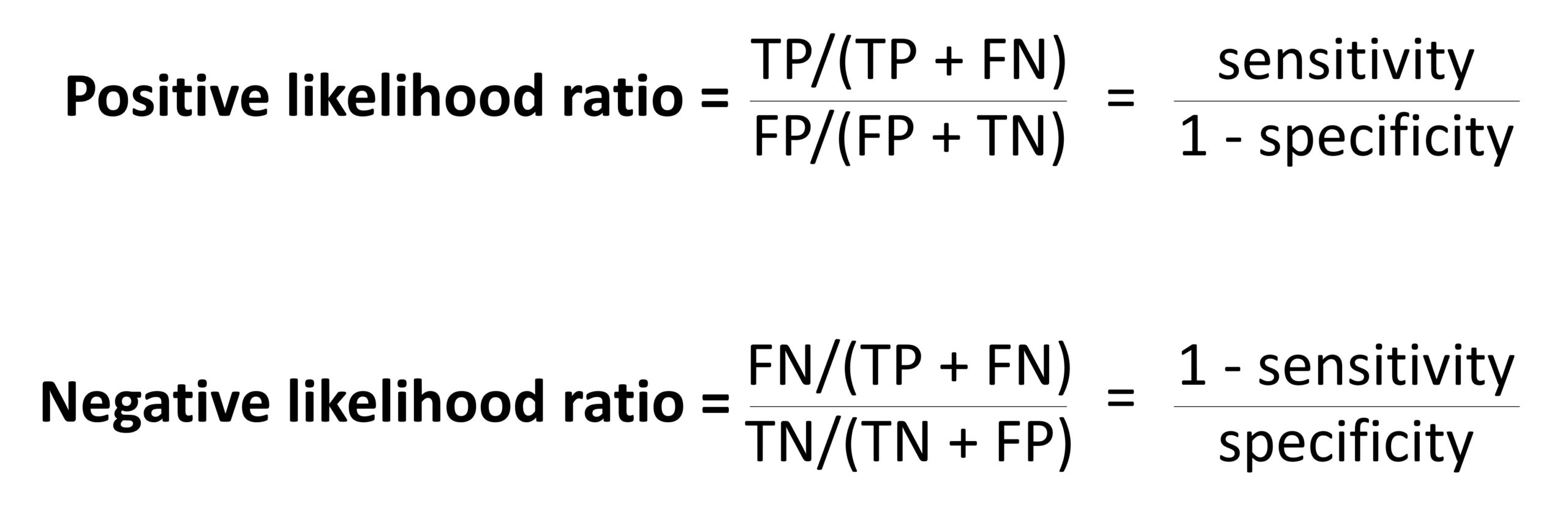
Positive likelihood ratios of >10 provide strong evidence for rule in (positive test is associated with the presence of disease), while negative likelihood ratios of <0.1 are strong indicators for rule out (negative test reliably excludes the presence of disease) [2,4]. Despite being considered as an important measurement, it is often not reported.
Translating urinary biomarker data into clinical practice
The clinical utility of implementing urinary biomarkers varies depending on the patient risk category and the biomarker performance:
- For patients with low- or intermediate-risk NMIBC, who have a considerably low risk of progression, a urine biomarker could be adopted for a marker-guided approach to postpone or reduce the number of invasive cystoscopic procedures (rule out). While some tolerability for missing a recurrence could be accepted – given that most recurrences are likely low grade and indolent – the urine biomarker should exhibit a high PPV to minimise the number of patients subjected to unnecessary follow-up procedures due to false positive results.
- For patients at high risk of disease progression, a marker-guided approach to reduce the number of cystoscopies would only be acceptable if the sensitivity for detecting high-grade recurrences is nearly absolute. Alternatively, the biomarker could be adopted as adjunct to cystoscopy and cytology to improve the detection of high-grade recurrences (rule in).
To safely implement urinary biomarkers in NMIBC follow-up, oncological safety, effects on health-related quality of life and cost-effectiveness ratio should be assessed in randomised controlled trial (RCT). Currently, a few RCTs are underway, with results expected soon for some.
Key takeaways
- Sensitivity, specificity, PPV, NPV and likelihood ratios are key properties of urinary biomarkers.
- Disease prevalence strongly influences the positive and negative predictive values.
- Urinary biomarkers are mostly useful for rule in in patients at high risk of recurrence, and for rule out in patients with low/intermediate risk.
- Some RCTs assessing whether biomarkers can be safely used to reduce/postpone cystoscopies are ongoing.
[References]
- Gontero P, Birtle A, Compérat E, et al. European Association of Urology (EAU) guidelines on non-muscle-invasive bladder cancer (TaT1 and CIS). Update March 2025. Available at: https://uroweb.org/guideline/non-muscle-invasive-bladder-cancer/
- Liedberg F, Mariappan P, Gontero P. Eur Urol Oncol 2025;8:234-6. PubMed
- Monaghan TF, Rahman SN, Agudelo CW, et al. Medicina (Kaunas) 2021;57:503. PubMed
- Deeks JJ, Altman DG. BMJ 2004;329:168-9. PubMed